


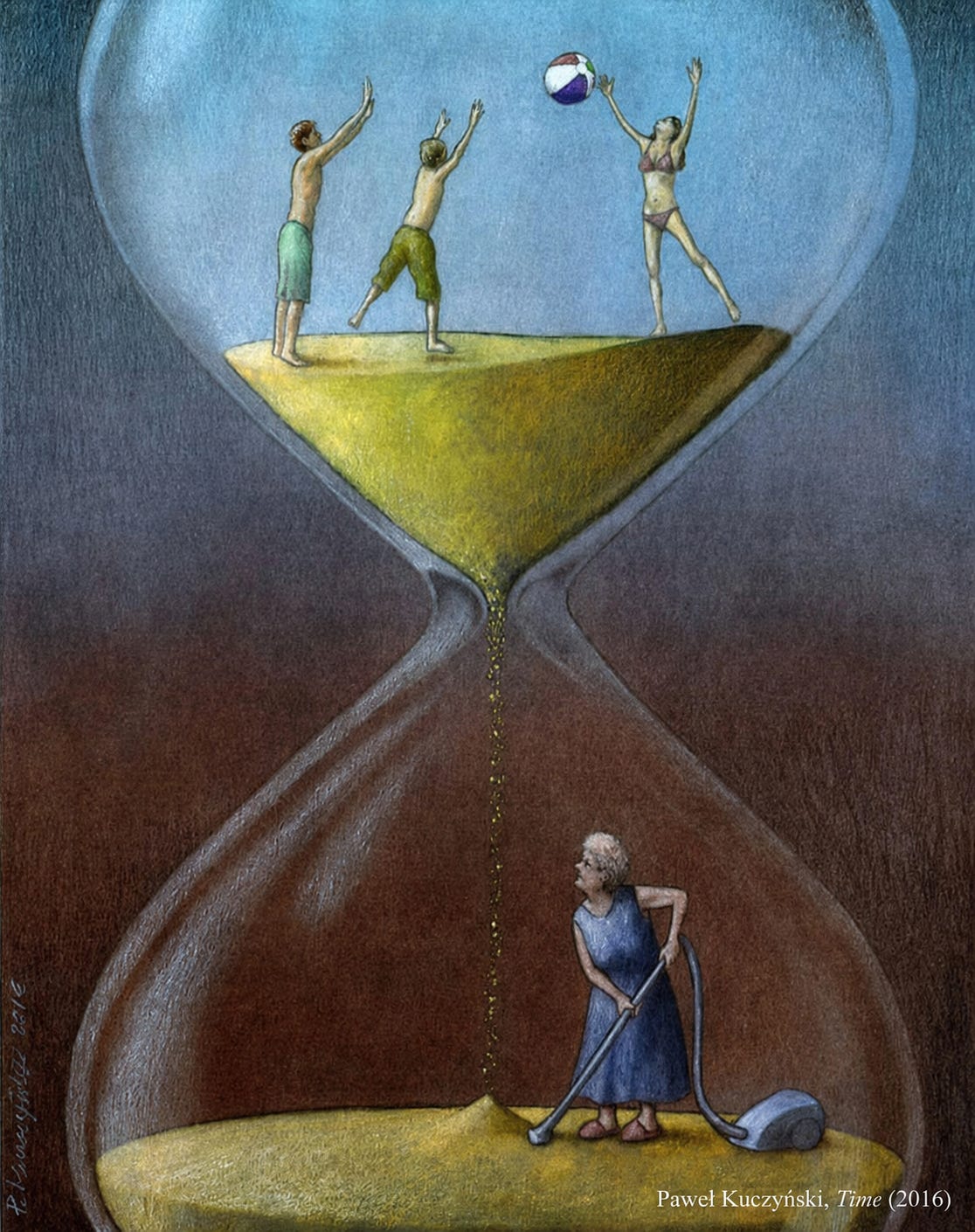
The letter arrives much earlier than expected, when you are twenty-six, or thirty-two, or forty-one, still young enough to have several identities left in you, and an envelope appears announcing that after years of careful preparation, you have finally qualified for retirement.
Not from work, but from uncertainty, which means you will no longer be required to embarrass yourself attempting things you might be bad at, enter relationships whose endings cannot be guaranteed, move somewhere you might regret, change your mind after everyone has memorized the old one, begin again without knowing whether beginning again was the correct decision, or spend unnecessary portions of your life wondering what happens next.
Your application for a predictable existence has been approved.
At first, this sounds wonderful, because there was a time when your life contained enough chaos that predictability felt less like boredom and more like rescue, when all you wanted were people who stayed, mornings without emergencies, plans that remained plans, and enough control over tomorrow that you could finally stop waking up prepared to negotiate with it.
Back then, chaos kept recommending the same treatment.
Routine.
So you took it.
You found your habits, learned your preferences, established your boundaries, became more careful about who entered your life, stopped making certain mistakes, and discovered several reliable ways to get through an ordinary week without everything catching fire.
Eventually, the emergencies became memories, the life you once begged for arrived, and after living inside it for a while, you said something incredibly ungrateful.
You were bored.
Welcome to Early Retirement
The retirement package is better than expected.
You are given familiar restaurants, familiar people, familiar weekends, and a small collection of problems for which you have already developed coping mechanisms, which means that even when something goes wrong, at least it usually goes wrong in a language you understand.
You become increasingly efficient at being yourself, learning what you like well enough to stop ordering what you might dislike, discovering which people make you comfortable enough to stop meeting very many new ones, and becoming so good at avoiding unnecessary discomfort that you accidentally begin avoiding most situations in which you might encounter a version of yourself you have never met before.
Nothing terrible is happening, which is important, because you are not miserable enough to leave anything behind; you are simply bored enough to wonder whether this is all there is.
Wasn’t this what you wanted, and wasn’t there a version of you who would have given almost anything for an ordinary Tuesday where nobody called with bad news, nothing collapsed, and tomorrow looked reasonably similar to today?
Yes, and that version of you was right to want it because they needed safety.
They just never said safety was supposed to become the rest of your life.
The Recreation Department
Eventually, you visit the retirement centre’s Recreation Department and explain that although everything is technically fine, you cannot remember the last time you were excited about Tuesday.
The employee behind the desk seems unsurprised and slides several brochures toward you.
TRY A NEW RESTAURANT.
START A NEW HOBBY.
TAKE A WEEKEND TRIP.
MEET SOMEONE NEW.
There is even a small pamphlet near the bottom of the pile that appears to say TEXT SOMEONE YOU KNOW YOU SHOULDN’T, although somebody has wisely crossed that one out.
So you begin following the recommendations, and for a while they work.
A new place wakes you up a little, a new person gives your mind something unfamiliar to study, a different weekend makes Monday feel briefly less predictable, and a new obsession provides several days in which you cannot believe you ever lived without knowing everything about whatever has just captured your attention.
Then the new restaurant becomes somewhere you have already eaten, the new hobby becomes something you now know how to do, the new person begins repeating stories, the trip becomes photographs, and eventually you find yourself back at the Recreation Department asking whether they have anything newer than new.
This is when you begin to suspect that novelty might be a terrible long-term treatment for boredom, because anything you keep long enough eventually becomes familiar.
You could travel somewhere different every month, change careers every few years, constantly meet new people and reorganize your life whenever it begins feeling ordinary, yet still discover that movement and direction are not the same thing.
If novelty were enough, nobody would ever become bored twice.
The Things You Keep Returning To
When novelty wears off, you sometimes return to things that never made you particularly happy because another repetition you recognize can still feel safer than a possibility you do not.
Familiar pain has one advantage unfamiliar possibility can never promise: you already know how it ends.
There are relationships you know how to disappear inside, habits whose consequences stopped surprising you years ago, and versions of yourself you keep resurrecting because even an outdated identity can feel comforting when you already know how to survive being that person.
Sometimes knowing that you can survive the ending is enough to make you choose it again.
Retirement from uncertainty has made you very good at surviving things you already know how to survive, but it has not told you what to live for.
The Person Down the Hall
There is someone in the retirement centre you have noticed for months because they appear to have an even more boring life than yours.
Every morning at nearly the same time, they sit at the same table near the window and work on the same thing, leaving for lunch and returning afterward only to continue exactly where they stopped, while you pass them on your way to another activity designed to make the afternoon feel different from yesterday.
One day you finally ask how they can stand doing the same thing every day.
They look at you as though the question itself has misunderstood something.
Of course they get bored sometimes.
That is not why they stop.
The answer bothers you more than it should, because you have spent years assuming that boredom was evidence something had become wrong for you, while this person seems perfectly capable of being bored without treating boredom as an instruction to abandon what they are doing.
Their days repeat too, perhaps even more than yours, but every hour is attached to something beyond itself.
They are making something, learning something, serving something, caring for something, becoming something, and the particular purpose almost matters less than the fact that their ordinary Tuesday has somewhere to go.
You suddenly realize that the two of you have been repeating yourselves for entirely different reasons.
You repeat because you know what happens next.
They repeat because they know what they are trying to reach.
The difference is direction.
The Problem With Early Retirement
Perhaps you misunderstood what stability was for because you thought the purpose of surviving chaos was to finally reach a place where nothing happened, when perhaps the purpose was simply to reach solid ground so that, for the first time in a long time, you could choose what deserved to happen next.
Routine was never the destination; it was the structure that allowed your life to stop revolving around emergencies and begin holding something larger than survival.
You established the habits, repaired what needed repairing, and created enough stability that your attention no longer had to spend itself putting out fires, and then, once everything was finally calm, you sat down and waited for stability to tell you what came next.
It cannot.
Routine can tell you when to wake up without telling you what deserves your waking hours, stability can protect your attention without deciding what deserves it, and discipline can help you repeat something for ten years while remaining completely indifferent to whether the thing being repeated was ever worth ten years of your life.
Maybe this is why boredom eventually arrives even in lives that are going well, because boredom is not always demanding excitement.
Sometimes it is asking where all of this is going.
Your Retirement Plan Was Incomplete
The longer you think about the person down the hall, the more you begin noticing that much of a meaningful life looks boring from the outside.
Almost everything worth keeping becomes repetitive if you are fortunate enough to keep it long enough, because love becomes ordinary, work becomes ordinary, talent becomes ordinary, dreams become ordinary, and even the life you once desperately wanted eventually becomes the life you wake up inside without remembering that there was a time when you would have begged to trade places with yourself.
Perhaps the goal was never to create a life in which you would never become bored, because such a life would require you to abandon almost everything the moment familiarity arrived.
Perhaps the real question is what you are willing to keep doing after it stops being interesting.
Boredom without direction feels like waiting, while boredom with direction can become discipline, because the same repetitive hour that feels unbearable when you are merely trying to make it disappear can become powerful when you know what that hour is helping you build.
You do not necessarily need to escape your routine.
You may need to give it an assignment.
There should be something your Tuesdays are carrying forward, something worth becoming bored for, and something important enough that you do not abandon it every time your nervous system stops rewarding you for showing up.
You spent years building a life stable enough to hold something, and perhaps the mistake was assuming that once the structure was finished, meaning would simply move in by itself.
It does not.
That part is still yours.
Congratulations
Eventually, you return to the envelope that started all of this and notice there is another page you never bothered reading because you were too excited about the benefits.
Most of the form has already been completed for you.
STATUS: STABLE.
MAJOR EMERGENCIES: NONE.
ROUTINE: ESTABLISHED.
UNCERTAINTY EXPOSURE: MINIMAL.
Everything has been approved, stamped and signed, except for one box near the bottom that the retirement office apparently was not authorized to complete on your behalf.
PURPOSE OF RETIREMENT:
You stare at the empty line for longer than expected.
There was a time when peace was the answer because chaos was the question, and you should never feel ashamed for building the ordinary life that once helped you survive, but surviving long enough eventually creates a new responsibility.
You have to decide what all that survival was for.
Everything is going according to plan.
Perhaps it is time to give the plan a reason.

Pull up a chair at The Writer’s Table. 🪑
Submit one piece you are especially proud of, then support another writer by reading their work and leaving a thoughtful comment.
Every Sunday at 7:00 p.m. ET, I feature three standout submissions. The winning piece receives a dedicated spotlight and is restacked. 🏆
Good writing deserves readers, and sometimes all it needs is a table where they can find it.
So thoughtful as always, Ajmal; I've missed your reflections.
We can spend years desperately wanting safety and then, once we finally have it, mistake the resulting boredom for evidence that something is wrong. In my case, I abandoned safety for adventure, and sometimes crave that boredom.
I really liked the “retirement from uncertainty” idea as a framing device.
As always, you write so intelligently.
Bisous,
Chloe
I kid you not I just escaped a phase of my life where I was trying to give my boredom some kind of meaning, because everyday looked somewhat the same and most days ended in me feeling like I was stuck in some sort of a limbo. I understand this article all too well and thankfully I have somewhat successfully gotten myself out of that limbo, so reading this felt like recounting my accomplishments!